Don’t Forget Your Margins – A Graphic Designers Primer on Bindery
As more graphic designers are being trained for web production instead of print, they tend to forget the small details, like setting proper margins when they’re creating print jobs that are going to be bound.
Most designers usually only make this mistake once, and then the lesson is remembered forever. But it can still be an expensive mistake to make, if you don’t have someone who catches it before the job prints, or if you have to do an expensive reprint.
Before you start, be sure you use the proper margin settings. When you setting up a new document in your page layout program, be sure you select the option that lets you set inside and outside margins, not left and right margins. You use left and right margins if you’re printing one-sided sheets, like a typical report. You should be able to select double-sided as a layout option, which should then activate the Inside/Outisde layout option.
Here are a few important points to keep in mind, based on the different bindery options.
- Saddle stitch: This is the typical staple-in-the-center bindery method. While you don’t lose a lot of interior space, you will lose a little on the outside. That’s because when you stack several folded sheets together, you start to get a fanning effect, where the innermost pages stick out beyond the front cover. When this happens, the pages have to be face cut, and you can lose as much as .25 inches off the outside margin. Talk to your printer and see what they recommend.
- Perfect Binding: Your typical book binding. Most book publishers want a 1.5″ margin for an inside margin. Take a look at a book, and see how much you’re able to see on the pages in the middle. As you get further into the book, the pages are harder to open, which means you need some extra white space. Some trade paperbacks, like the Dummies series
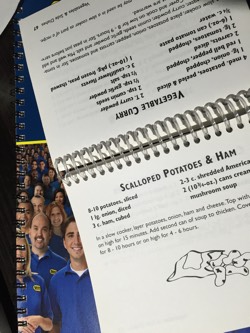
- Comb, Coil, Spiral, and Wire binding: These books are made to lay flat, unlike perfect bound books. It’s like laying two stacks of paper side by side, with about a .25 inch gap between them. Because of this, graphics should not cross pages. That is, don’t create a two-page photo spread, especially if you’re going for something really fancy and high class. You can do it with saddle stitching, especially if you can land it on the center page of the book, but it just doesn’t look good with these spreads. The margin for these books should run around 1.5″, but can go up to a 2″ inside margin. Talk to your printer to find out what he or she recommends.
A Graphic Designers’ Binding and Print Finishing Cheat Sheet
Avoid wasting money by knowing a bit about binding and print finishing
In producing sizable publications, what happens in the last step — the print finishing and binding process — has to be considered in the first step — the design phase. Graphic designers who fail to do this will inevitably design publications in which the text and images end up in the wrong place. The result can be costly re-design, re-printing and re-binding work.
(I’m grateful to Christopher James Noble, Director of CMYKreative in the UK, who covered this subject in detail in an article.)
To avoid wasting time and money, the designer should know something about each type of binding and print finishing and the bindery equipment required for the job. To summarize, in professional print finishing and binding, here are the most common processes:
Saddle stitching is simple and cheap and often all that’s needed. Loose sheets are laid over a saddle-like holder where staples are forced through the spine of the pages at a very rapid rate. The more pages in the publication, the more likely pages will “creep” as they move through the process. So you should allow for larger margins, particularly if the outside edge of the bound job is to be trimmed flat.
Side-stitch binding is similar to saddle stitching, except that the staple is forced through the sides of the pages near the folds instead of through their spines. The resulting binding is not quite as nice as saddle stitching, so don’t use this if you’re releasing this to an audience who needs to be impressed by your work. Plus, this will chew up a lot of margin space, so allow for at least a 1.5″ inside margin.
Perfect binding starts with all of the project’s pages placed together and stitched through the spine. Then the spine edge is ground flat and the cover is glued on. While page creep is less of a concern, wider inside margins may be needed to prevent page content from disappearing into the center of the publication, particularly if there are many pages.
Case binding is almost the same as perfect binding, with the added step of reinforcing the spine with a cloth strip before attaching the cover. Treat it like perfect binding when laying out margins.
In comb binding, the plastic teeth of a comb are inserted into rectangular holes punched along the edge of the pages. This allows the finished publication to lie flat when open and the spines can be removed and reattached. But adding a printed spine is difficult and wider inner margins are needed to keep text and images away from the holes. If you want to do a two-page spread of data or images, don’t. If you have to, cut the image or data, figure the margin space, and have the information jump the page. Otherwise, you lose important information in the holes and the comb.
Coil or spiral binding involves threading a wire or plastic spiral through round holes punched in the edges of a stack of the pages. This method also allows the finished publication to lie flat when opened. The inner margins of pages must be wide enough to prevent punching holes into page content, and it’s very hard to add a printed spine. Again, it’s hard to have a two-page spread for data or a photo, although it can be done. The problem is getting two lines of data, like a spreadsheet, to line up properly, especially on a spiral. If you have to do that, consider. . .
Wire binding uses tooth-like loops of wire in a fashion similar to comb binding, but produces a much sturdier binding. Plus, the pages open perfectly in line, so you can keep lines of data perfectly aligned.
Post binding is simply a few metal posts pushed through punched holes in the pages and anchored with bolts that thread into the center of the posts. The final publication can have an external cover with an imprinted spine. Pages can be added or removed easily. Again, what’s printed on each page could be lost from view in the center if the interior margins are not wide enough. Figure a 1.5″ inside margin here too.