Don’t Forget Your Margins – A Graphic Designers Primer on Bindery

August 12, 2009 by · 2 Comments
Filed under: Binding, Graphic Design, Print Shop 

As more graphic designers are being trained for web production instead of print, they tend to forget the small details, like setting proper margins when they’re creating print jobs that are going to be bound.

Most designers usually only make this mistake once, and then the lesson is remembered forever. But it can still be an expensive mistake to make, if you don’t have someone who catches it before the job prints, or if you have to do an expensive reprint.

Before you start, be sure you use the proper margin settings. When you setting up a new document in your page layout program, be sure you select the option that lets you set inside and outside margins, not left and right margins. You use left and right margins if you’re printing one-sided sheets, like a typical report. You should be able to select double-sided as a layout option, which should then activate the Inside/Outisde layout option.

Here are a few important points to keep in mind, based on the different bindery options.

  • Saddle stitch: This is the typical staple-in-the-center bindery method. While you don’t lose a lot of interior space, you will lose a little on the outside. That’s because when you stack several folded sheets together, you start to get a fanning effect, where the innermost pages stick out beyond the front cover. When this happens, the pages have to be face cut, and you can lose as much as .25 inches off the outside margin. Talk to your printer and see what they recommend.
  • Perfect Binding: Your typical book binding. Most book publishers want a 1.5″ margin for an inside margin. Take a look at a book, and see how much you’re able to see on the pages in the middle. As you get further into the book, the pages are harder to open, which means you need some extra white space. Some trade paperbacks, like the Dummies series
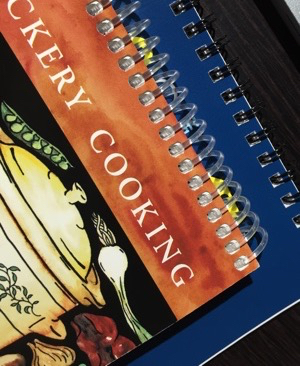
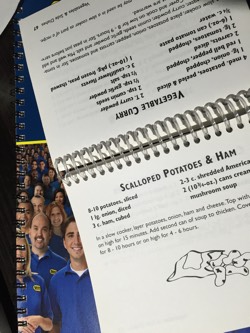
  • Comb, Coil, Spiral, and Wire binding: These books are made to lay flat, unlike perfect bound books. It’s like laying two stacks of paper side by side, with about a .25 inch gap between them. Because of this, graphics should not cross pages. That is, don’t create a two-page photo spread, especially if you’re going for something really fancy and high class. You can do it with saddle stitching, especially if you can land it on the center page of the book, but it just doesn’t look good with these spreads. The margin for these books should run around 1.5″, but can go up to a 2″ inside margin. Talk to your printer to find out what he or she recommends.

The Benefits of Spiral/Coil Binding Over Perfect Binding

Ask any manufacturer or reseller of spiral wire or plastic coil binding equipment about the advantages of their finishing equipment, and they’ll go for hours. The same is true for the perfect bound guys. That may be because we’re all a little weird that way, but each of us believes in our system.

On the one hand, the perfect bound folks want to talk about style and high-end finishing. It looks nice, it stacks well, and how many real books have you seen with a big wire running through its spine?

On the other hand, the spiral/coil binding people aren’t concerned with that. They understand that perfect binding is good for some things. They’ve even got real books in their house. But they’re more interested in things like cookbooks, technical manuals, reports, atlases and travel guides are ideal for spiral binding.

“Imagine trying to open a perfect-bound atlas and the one spot you need to find is buried inside the binding,” the spiral/coil guys will say. “Now, if you had a spiral or coil atlas, you can open the book all the way up without damaging the spine or losing anything in the binding process.”

Spiral and coil finishes allow you to lay a book flat, or open it 360 degrees. Let’s see you do that with a perfect bound book.

Plastic spiral binding is also the only method that can be done by hand. We actually sell machines that will punch the holes into your pages, insert the binding coils, and let you place the pages. Sure, you don’t want to do this when you have a few thousand books to do — you’re better off sending it to a professional bindery if you’ve got more than 500 to do. But it’s a nice piece of equipment to keep around the office if you’re just doing 1 – 10 books at a time every few days, or a short run of 250 books especially if you have to do individualized pages for client proposals, project specs, or even just updating and creating new versions of pages on a regular basis.

That’s because plastic spiral binding is also the only method (of two) that you can take apart, change pages, and put back together again. (We’ve got another hot glue method that we’ll discuss in a future post.)

While we like the look of perfect binding, and we believe it has some great uses, there are times that it just can’t beat the utility and ease of use of a spiral or coil bound book.

How to Create a Magalog

Most people can deduce from the name that a magalog is a combination of a magazine and a catalog. That’s true, but I also like to think of it as an expanded sales letter with glossy images, engaging text and advertorial content.

The look, feel and style of a magalog is just as important as its content. So, think bold covers, big headlines, glossy pages and contemporary design and you’re starting to get the idea.

It’s also important to note that a magalog isn’t always a direct sales tool the way a catalog might be. For example, you may simply want to promote brand awareness, push a specific event, encourage a response or solicit new contacts. Of course, your end goal is going to be sales, but that doesn’t necessarily mean all magalogs have to have an order form on the back.

How can companies create their own magalog?

1. Create and Design

Because so much of a magalog’s appeal is about its design, look and content, the majority of your efforts (and budget) are going to (or should be) be directed towards those areas. That means hiring an editor and writers or enlisting gifted staff members to write articles and content for your magalog. It also means finding a designer able to create a look and style that mimics popular magazines.

You’re investing a lot when you create, print and mail a magalog, so the last thing you want is for it to end up in the garbage with the rest of the junk mail. To prevent that, you need a good-looking product that’s engaging to the reader.

I know that printing is listed as step two here, but you should really be talking to a printer before you begin the design process and throughout it. A magalog is a complex beast and a good printer can help with suggestions that will lower costs (both printing and mailing) or prevent you from spending thousands on a cut-out, embossed design that could end up costing thousands more just to print.

Despite my protests that a magalog needs to be glossy and big to grab a reader’s attention, there are exceptions. For example, I’m looking at what’s essentially a magalog that we picked up from Whole Foods grocery store a few weeks ago. It’s printed on rough, recycled paper with a minimal use of inks and dyes. It’s useful because it’s full of lunch ideas for kids, recipes, and articles on food choices (not to mention coupons and piles of sales copy).

2. Print

Again, printing may be listed here as step two, but your printer should really be part of the whole magalog process right from the beginning. They can help guide your design, answer cost questions and assist you in developing a final budget for the project.

When choosing a printing company, look for someone with an in-house bindery and binding equipment capable of doing the whole job at one location. The more cooks in your kitchen, the more complex (and costly) your project will be. Instead, look for a printer that has the offset printing and binding equipment necessary to do the whole job.

Finally, never proof a magalog digitally. Always deal with a real, printed and tactile proof that you can hold in your hands, feel and really look at. A magalog’s appeal goes beyond its look or flashy design and extends to its weight, readability and how it feels in the reader’s hands.

3. Distribute

Most magalogs go out by mail and to a specific target list of customers. They’re either sent as media mail self-mailers or shipped in envelopes and the total cost of mailing depends, of course, on the size and weight of each unit (something to consider throughout your design process).

Other magalogs are distributed directly to the consumer at the point of sale (like the Whole Foods’ magalog flyer), at an event or through free newstands.

Finally, remember that not every company needs a magalog in its arsenal. It’s better to wait until you have the resources, the content and the potential customer base to make a good magalog then spend your money on a subpar product. And, always ask yourself, “why do I want to create a magalog?” Don’t do it because it’s popular, do it because it’s the right sales tool for your customers.

8 Common Print Binding Techniques

July 24, 2009 by · Leave a Comment
Filed under: Binding, Print Shop, Products 

Cost, content and target audience should influence your choice of print finishing and binding.

In today’s media market, every publication you print has to work harder than ever before to impress its audience and properly present its content. Yet cost control has never been more important. That’s why it’s so important to match your audience, content and budget with the right type of print finishing, binding process and bindery equipment. Here are some considerations for the printer who’s committed to pleasing the client:

  • Saddle stitching is inexpensive and is well suited for large press runs, such as with a mass-market magazine. In this binding method, loose sheets are laid over a saddle-like holder where staples are forced through the spine of the pages at a very rapid rate. Investing in bindery equipment for saddle stitching would make the most business sense when the volumes are high and the publication’s shelf life is short.
  • Side-stitch binding is an option when the publication is small, impressing an audience isn’t the goal, and unit costs must be very low. The process is similar to saddle stitching, except that the staple is forced through the sides of the pages near the folds instead of through their spines. It will give you a less attractive and less durable binding.
  • Perfect binding is the best choice when the publication is larger (50 pages or more), the audience is more up-market and/or the look and feel of the publication must imply that its content is special and substantial. Annual reports, textbooks and upscale magazines are typically perfect bound. In this process, all of the pages are placed together and stitched through the spine. Then the spine edge is ground flat and the cover is glued on.
  • Case binding makes sense when the publication must be very durable as well as impressive. The process is almost the same as perfect binding, except that the spine is reinforced with a cloth strip before the cover is attached.
  • Comb binding is ideal for business reports, cookbooks and workbooks because it allows the finished publication to lie flat when opened and permits pages to be added and removed. This method is also used by companies to bind internal, short-run publications, such as training and product manuals and other publications not intended for customers or not subject to hard use. In comb binding the curved plastic teeth of a comb are inserted into holes along the edge of the pages.
  • Coil or spiral binding also allows the finished publication to lie flat when opened. In this method, a wire or plastic spiral is threaded through round holes punched in the edges of a stack of the pages. While the finished binding is more durable than with comb binding, pages can’t be added or removed. You might use this process for journals, student workbooks or other publications intended for frequent or hard use.
  • Wire binding uses tooth-like loops of wire in a fashion similar to comb binding, but produces a much sturdier binding because the binding material is metal instead of plastic.
  • Post binding is for heavy-duty publications with constantly changing content. Examples include scrapbooks, photo albums and carpet sample books. The binding process is simply metal posts pushed through punched holes in the pages and anchored with bolts that thread into the center of the posts.

Each binding method also has variations involving the use of special materials — such as ribbons or screws — and more manual labor. Unit cost is higher, but the resulting publication will stand out. Commemorative albums, special event programs and menus are some of these specially bound publications.

For any printer considering the purchase of bindery equipment, the most important consideration, of course, is what your customers want. If they all have similar needs, then you need only a limited range of binding capabilities to satisfy them. But if your customers’ expectations are diverse — or if you’re planning to expand into new markets — then the wider range of capabilities that come with having a wider range of bindery equipment would make the best business sense.

Why Perfect Binding May Be the Perfect Print Finishing Option

It’s hard to beat perfect binding for a look and feel of completeness and professionalism. It just seems to say, the content in here is important.

Perfect binding is also very versatile in terms of what can be bound. You can bind in two-page signatures, which allows you to produce the best page count for your situation and also permits inserts. (A “signature” is a group of pages that are folded together in groups. You bind several signatures, rather than binding separate sheets.) In fact, perfect binding can accommodate almost any kind of insert — fold-outs, response cards, tear-away envelopes, magna-strip tip-ons, sticker pages, and many other kinds.

But even with its advantages, as Adam Trull of Acme Printing recently pointed out , perfect binding isn’t without its challenges, whether you contract out the job or do it on your own bindery equipment.

One challenge is cross-overs — images that straddle the gutter between adjacent pages. Cross-overs don’t necessarily preclude the use of perfect binding, but there several details to be addressed in order to get properly aligned cross-over images in your perfect-bound book. Before committing to perfect binding, you should make sure your pre-press professionals and printing team have experience setting up and producing perfect-bound books with cross-overs.

Another factor is spine strength, which is usually measured by a machine that holds the book open and pulls on a center page until it separates from the spine or tears. The industry standard is 2.5 pounds per linear inch. Spine strength is a more important consideration for oblong books because they tend to lie flatter, thus putting more strain on the spine and making it weaker.

Obviously, your choice of glue will affect the perfect-bound book’s spine strength. EVA (ethylene vinyl acetate) is most often used for books that will be read casually. PUR (polyurethane reactive glue) is stronger, but it costs more and requires 24 hours to dry. In either case, it’s a good idea to keep ink and varnishes out of the glue area so the glue gets a better grip on the paper fibers.

If you need to produce perfect-bound documents frequently and in various quantities, you should consider purchasing your own bindery equipment so you can produce a variety of perfect-bound documents on-demand.

One example is the DFG Digi Express perfect binding machine, which is fast and very easy to use. You can get one from Lloyd’s of Indiana for less than $6,500.