The Print Finish Blog
by The Print Finish Blog

5 Tree-Free Papers

May 26, 2009 · Filed Under Green Printing, Print Shop · View Comments 

The Sustainable Printing blog hosted on Today.com recently posted a great piece covering the five most popular, tree-free green printing papers available today.

Not all of them are widely available or cost-effective, but a few are catching on in the green printing industry as viable alternatives to traditional tree-fiber.

Hemp Paper

It grows fast, has incredibly high yields and it’s durable — making hemp an incredibly versatile material. For most commercial applications, hemp is combined (usually in a 1:3 ratio) with recycled tree-derived paper stock.

Unfortunately, this process of recycling, washing and bleaching recycled stock and then combining it with hemp fiber uses a lot of water, electricity and resources. If your goal is sustainable printing, I recommend investigating both how this particular paper was manufactured and the size of the manufcaturer’s ecological footprint.

Cotton Paper

Cotton paper is bright, white and beautiful to work with. It feels amazing between your fingertips and it actually lasts much longer than traditional tree paper. However, cotton paper is also exceptionally expensive.

There’s also the sustainable printing argument that growing that much cotton to sustain a paper industry would require an epic amount of farmland and more resources (watering, maintaining, processing) than tree-derived papers. So, while cotton may be green paper in small amounts, it doesn’t scale well into mass production.

Kenaf Paper

Like hemp, kenaf grows quickly and produces a high yield. And because kenaf is naturally white, it requires significantly less bleaching than paper made from tree fibers. Today, kenaf is poised to be the next big green paper in the sustainable printing industry.

Bamboo Paper

I’ve heard of bamboo socks, but did you know they also make bamboo paper? Though not widely available, bamboo paper is being developed and marketed as a green paper. It’s expensive, but if it catches on, the price could come down.

Rock Paper

No, not Rock Paper Scissors. Rock paper is essentially made from limestone and will eventually break down over time, particularly when exposed to the elements. There’s no bleaching involved, but don’t expect long term durability with this green paper choice.

Photo: Joi (bamboo)
Photo: Ingermaaike2 (hemp yarn)

Recycled Paper Quality Same as Virgin Paper

May 20, 2009 · Filed Under Green Printing, Print Shop, Small Business · View Comments 

A process that has been around for many years, but is still relatively new to the public is paper recycling. It’s an important process in green printing and in keeping the environment healthy.

So just what is paper recycling?

It’s a process of recovering waste paper and remaking it into new paper products. Almost any household paper can be recycled, including used newspapers, cardboard, packaging, stationery, direct mail, magazines, catalogues, greeting cards and wrapping paper.

Waste paper can be disposed of in three ways. It can be buried, burned, or recycled, and it goes without saying that recycling is the preferred method of “disposal.” There are three categories of paper that can be used as feedstocks for making recycled paper. These are mill broke, pre-consumer waste, and post-consumer waste.

Mill broke is paper trimmings and other paper scrap from the manufacture of paper, and is recycled internally in a paper mill. Pre-consumer waste is material that was discarded before it was ready for consumer use and post-consumer waste is material discarded after consumer use such as old magazines, old telephone directories, and residential mixed paper. Paper that is suitable for recycling is called scrap.

And it makes a lot of sense to buy recycled paper. Paper purchasers can protect the environment, save money, and purchase the best papers available just by buying recycled paper.

A few reasons to buy recycled paper

  • It meets the same technical specifications as virgin papers, it runs on the most demanding copiers, office machines, and printing presses.
  • Many recycled copy papers work well in copiers.
  • It comes in a variety of colors, is available in virtually every grade of paper.
  • Financially it’s an accountant’s dream as it’s no more expensive than regular “virgin” paper.
  • Using recycled paper saves trees, energy, water, and landfill space.
  • It produces less pollution than virgin paper production.
  • It offers environmental savings many times over, since fibers can be recycled repeatedly.
  • But what about the quality of recycled paper?

    It’s true that as late as the 80s, recycled paper was often of uneven quality, sometimes appearing dark and spotted. Throughout the years, the quality has improved immensely. Today’s recycled paper is available in all colors, including the brightest whites, and meets the highest technical standards, sometimes even exceeding comparable virgin papers. Commercial printers and copier machine manufacturers today agree that recycled paper is suitable for all their machines. They only require good quality paper, whether recycled or virgin.

    According to an interview in the Epoch times, Bernd Krause of the Federal Envirnmental Office, there’s no question recycled paper is of high quality.

    “Quality recycled paper is very similar to that of virgin paper,” Krause replied, “and certain criteria must be met before we approve of the eco-label, including that standards be met for the intended end-use of the product. The product produced from recycled fibers must be of at least the same quality as the product produced from virgin fibers.”

    A ringing endorsement like that can only encourage more printers to use recycled paper and also to encourage more people to recycle their waste paper.

    Photo: Jetalone

    Use Options to Save Printing Costs

    May 5, 2009 · Filed Under Print Shop, Sales and Marketing · View Comments 

    Money’s tight and your customers want to see some cost savings. So, how are you going to deliver the same high-quality printing services along with a few cost-cutting measures for your customers? The answer is options.

    By providing your customer base with a few lower-priced options, you can save your clients – and your own company – money.

    Offer a House Stock

    Keep a house stock of paper. Buying in larger quantities will save you money and you can pass that on to your clients. Also, let your customers know that printing on standard stock and standard sizes are going to save them money.

    Provide Ink Choices

    You may want to offer greener printing choices, but if switching to “green” inks means raising your prices across the board, you may want to simply give your customers the option. They can choose “green” inks, but at a premium. Customers looking for environmentally-friendly printing options will appreciate the choice, as will those looking for cost savings.

    Deeper Quantity Discounts

    If you can afford it, cut some deeper quantity discounts. In this tight economy, you might encourage a few clients to dig deeper themselves for larger, more evergreen orders.

    Submit a Quote with Options

    I’ve got a friend who works for a printer that sends multiple quotes for the same job. They basically say this is how much it is with the embossed, glossy cover, but this is how much it will be with a plain, coated card stock cover.

    So, instead of cutting themselves out of a bid by packing their quotes with high-end features, they offer a low-end option that gets them in the door. Guess what happens? A large portion of their clients end up choosing their higher-end options anyway.

    Tell Your Customers How to Save

    You’ve probably heard the term “value added” over and over, and are as sick of it as we are. But as overused as it is, this is where you can set yourself apart from your customers. Don’t just print whatever the client hands you, because they don’t always know what will be the most cost-effective, what problems they may have down the road, or whether they’ll even be happy with what they created. Give them some free consulting and add value to what you offer.

    Send out a letter, give them a handout or put it in a newsletter, but tell your clients how they can save money on their print jobs. Give them tips about opting for standard sizes, planning ahead, choosing more “evergreen” designs or purchasing in bulk. Trust me, they’ll appreciate it and they may just repay your kindness with increased business.

    Times are tough and we’re all having to fight a little harder for our sales, but by providing your print customers with cost savings options you’re setting yourself apart from the competition, especially in this economic climate.

    Paper Joggers Rock

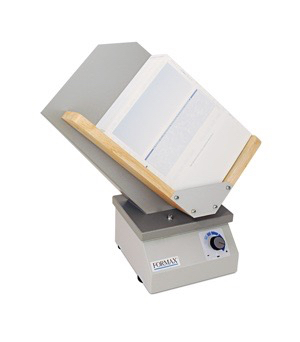
    The Formax FD 400P1 Paper Jogger is like a helping hand that makes any sealing, sorting, cutting or folding job go faster and easier, while minimizing paper waste.

    What Does it Do?

    What does a paper jogger do? In the simplest of terms, it vibrates and shakes up the paper. So what? Well, all that movement actually reduces static electricity and ensures the paper is squared up and properly aligned. That means no more misaligned or off-centered print jobs and no more stacks of paper stuck together.

    The Formax FD 400P1 is a single bin paper jogger, making it the smallest of the Formax jogger series. But, it’s still powerful – it can handle up to 1 ½ reams (750 sheets) of 20# paper and up to 8 ½” x 14” legal.

    The Formax FD 400P1 is also elegant. With a simple on/off switch, it requires no special training or complex manuals, just flip, jog and feed.

    And How Much Does it Cost?

    Customers can pick up the Formax FD 400P1 for $765 on the Lloyd’s of Indiana website. Lloyd’s extended warranty options are also available.

    You can learn more about the Formax FD 400P1 Paper Jogger here.