How Do I Choose the Right Business Card Slitter for My Print Shop?
In this series of posts, “How do I choose?”, we will help you take a little of the guesswork out of selecting the best print finish product for your shop or office. It’s sometimes difficult to find the right machine to fit your needs when there are so many models.
Ah, the business card. Still a valuable business tool after all these years. If you’re a full-service shop, you’re likely printing business cards for clients that use your other services. If you’re not, you may be missing out. It’s a nice little revenue stream that requires very little work, and even less up-front investment. That is… if you’ve chosen the right business card slitter.
But how do you do that?
When it comes to business cards, you must consider volume and automation. The more volume you expect, the more automated you probably want to be. Automated business card slitters like the HS-3000 will cut and stack 1,000 cards in five minutes ready to box and deliver. When you’re doing cards for an entire company that’s just gotten a new logo or street address, the speed and accuracy of a machine like this comes in handy.
Manual models are still efficient and are certainly not slow, and they have the advantage of being extremely economical. Lloyd’s has a great selection of both manual and automatic card slitters.
The thing to consider when buying either model is the format in which you’ll print the cards in the first place. 8-up, 10-up, 12-up, gutter, or no gutter are all options. Just remember, the flexibility and speed your print shop has in cutting business cards may just keep your customers from exploring purchasing one of these machines on their own. These machines are so easy to operate, they’re also sold as “ideal for the office.”
How Do I Choose the Right Binding Machine for My Print Shop?
In this series of posts, “How do I choose?”, we will help you take a little of the guesswork out of selecting the best print finish product for your print shop or office. It’s sometimes difficult to find the right machine to fit your needs when there are so many models.
It all has to come together sometime. All those pages in the presentation, the employee manual, the book, the instructional guide, the schematics… They’ve all got to have some sort of binding to meet the customers budget, the readers needs and a style that looks good. But, what kind of binding machine do you need?
Well, the answer to this one is a little trickier. You may even want more than one machine. First you need to determine the type of binding that you think you’ll use most often.
- Comb binders – cheap, effective. Plus, combs can be opened to add/subtract sheets.
- Coil/Wire binders – Comes in a variety of colors and materials. Allows the reader to lay the book open flat and turn pages a full 360-degrees.
- Unibind binding machine – Quick, slick and permanent. A steel spine at the back of the cover allows the paper edges to sink into a heated resin.
- Perfect bound machines – Most paperback books at your local retailer are bound with this method. It’s glue-based and leaves a nice sturdy spine.
Once you’ve chosen a couple binding methods that you’d like to offer at your shop, consider flexibility, speed and cost.
You’ll certainly find flexibility with a combo system. A single purchase will allow you to do both comb, wire or coil (depending on the machine). However, keep size in mind. With comb or coil systems, you may not want to limit yourself to standard 8 1/2″ x 11″, so investigate the machines that can accommodate 14″ or 17″ sheets. Speed is affected by manual or automatic operation and the number of sheets that can be punched at one time.
The most crucial consideration however, is the question of cost. What you can sell and what your customers are willing to pay for may limit your choices. A perfect binding system is expensive initially, but costs little in upkeep. The Unibind thermal system itself is inexpensive considering the nice end product, but supplies are comparitatvily high, per piece. So, remember not to merely look at the machinery that makes the binding happen. Look at the plastics and metals that make up the binding.
How Do I Choose the Right Document Inserter for My Office?
In this series of posts, “How do I choose?”, we will help you take a little of the guesswork out of selecting the best print finish product for your shop or office. It’s sometimes difficult to find the right machine to fit your needs when there are so many models.
It’s one thing to upgrade the speed and efficiency of your office by choosing the right folding machine, but you can take invoices and other direct mail to a new level of automation with a document inserter. Because you’ll be investing significantly more on an inserter than you would a simple folding machine, it’s important that you weigh the benefits of each tier of functionality.
More than speed, which varies slightly between models, document inserters are primarily distinguished by the number of items that may be inserted into mailing envelopes. When shopping, you may consider that at this time you only ever insert an invoice, a form letter and a return envelope into 90% of your mailings. In that case, the Formax 6202 is a perfect machine for your operation.
However, you must consider growth in your business, change in operating procedures, and things as simple as the two-page invoices that make up only 10% of your mailings take all afternoon for two staff members. What is the opportunity cost there? What’s the phrase about being as strong as your weakest link? Don’t let a little bit of underused functionality get in the way of what could be a fully automated process.
Then, consider what your office could do with an even more advanced inserter. A new strategy with direct mail may add a significant line of revenue to your budget. What value could you add to your customers? To your employees?
Answer these questions and shop Lloyd’s for the best deal on document inserters. The models we carry all have warranties and are virtually maintenance free.
How Do I Choose the Right Paper Cutter for My Office?
In this series of posts, “How do I choose?”, we will help you take a little of the guesswork out of selecting the best print finish product for your shop or office. It’s sometimes difficult to find the right machine to fit your needs when there are so many models.
What are you cutting at the office? Yes, I know someone has to cut the cake for the secretary’s birthday, but that’s not what I mean. It seems we all end up doing some sort of paper crafts once and a while. Trimming down those photos for the traveling exhibit, cutting out stacks of pamphlets to fill the marketing rack in the reception area, slicing up that spreadsheet that mistakenly printed on the ginormous paper in the bottom drawer.
Every office needs a paper cutter, the only question is, which one?
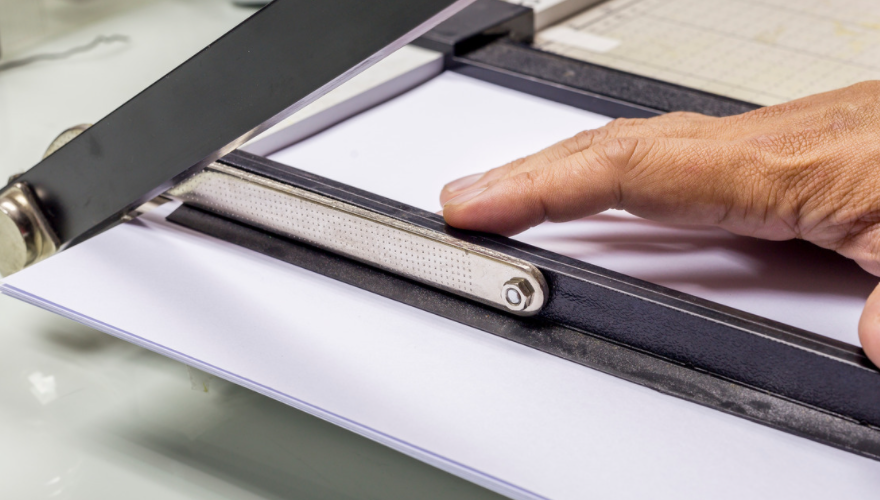
Paper cutters basically come in two flavors these days – Guillotine and Rotary. Like many other items in this series of posts, you need to consider volume and speed. But, you also need to take into consideration the safety of your staff and how accurate cuts need to be.
Guillotine paper cutters are commonly found in offices. They’re sharp, can cut through multiple sheets with ease, and there are some great measurement guides on the working surface. Multiple sheets at a time speaks to the volume necessity, but often works against accuracy. The clamps and lockable gauges of the Kutrimmer tabletop trimmer assist with accuracy, but its most impressive additions are safety features. Different models of guillotine cutters basically allow for larger sheets and more working space.
The most accurate cuts will always be made with Rotary cutters. My personal fav is sold at Lloyd’s. The Roll-Blade rotary trimmer not only has great measurement guides and a self-sharpening tungsten blade, but it also cuts through cardboard and some plastic with just as much accuracy a it does with paper. And, unless you’re really trying, it’s virtually impossible to cut yourself with this rotary.
How Do I Choose the Right Corner Rounder for My Print Shop?
In this series of posts, “How do I choose?”, we will help you take a little of the guesswork out of selecting the best print finish product for your shop or office. It’s sometimes difficult to find the right machine to fit your needs when there are so many models.
For example, Lloyd’s has nine different round corner machines. There are options and add-ons for some, and others are simply manual. In each purchase you make, you should consider the following as it relates to your business’s operation.
Corner rounders are pretty simple machines. They basically make measured cuts on the corner of your printed sheets. This finishing method has always been popular, but more-so in recent years as print products mimic the style of online communications. It’s not often that you see an icon or a photo online with squared-off corners.
So, let’s look at application first. Are you printing posters or business cards? Are you printing on heavy or standard stock? The size alone may rule out a manual table-top rounder, so be sure to look at the table dimensions. And, heavy stock may require the power an automatic can provide – which also puts you over $1,000. If you’d like the option to cut through metal for signage production, you’ll need a specific machine.
For rounders I think quantity and speed necessary can be measured by the capacity of sheets you can feed the machine at one time (in inches). A rounder in the hobby category may only accept a few sheets at a time with a .04″ clearance, but commercial medium and heavy-duty rounders will allow an inch or more to be cut. Thicker cut, means you’ll be moving through projects faster. Do you think your capacity will grow or remain the same? Choose a model for 2 years down the road, rather than one you need today, because your needs will hopefully grow once you add this machine.
The frequency of your use will require replacement cutting dies, so the availability and cost of these parts should also be a consideration. You’ll also want to investigate the variety of blade sizes and designs available for a particular model as well. A wide variety of cutting options will also add to your flexibility and options for the customer.
Finally, consider maintenance. All Lloyd’s corner rounders come with a year warranty, but looking beyond this time frame consider your potential frequency of use and the availability of replacement parts.
To check out Lloyd’s selection of corner rounders and compare models, visit our website.